
2027 Sticker Design Contest
A winning design will be chosen as Project SAGE’s Teen Dating Violence Awareness Month 2027 sticker.
For Teen Dating Violence Awareness Month
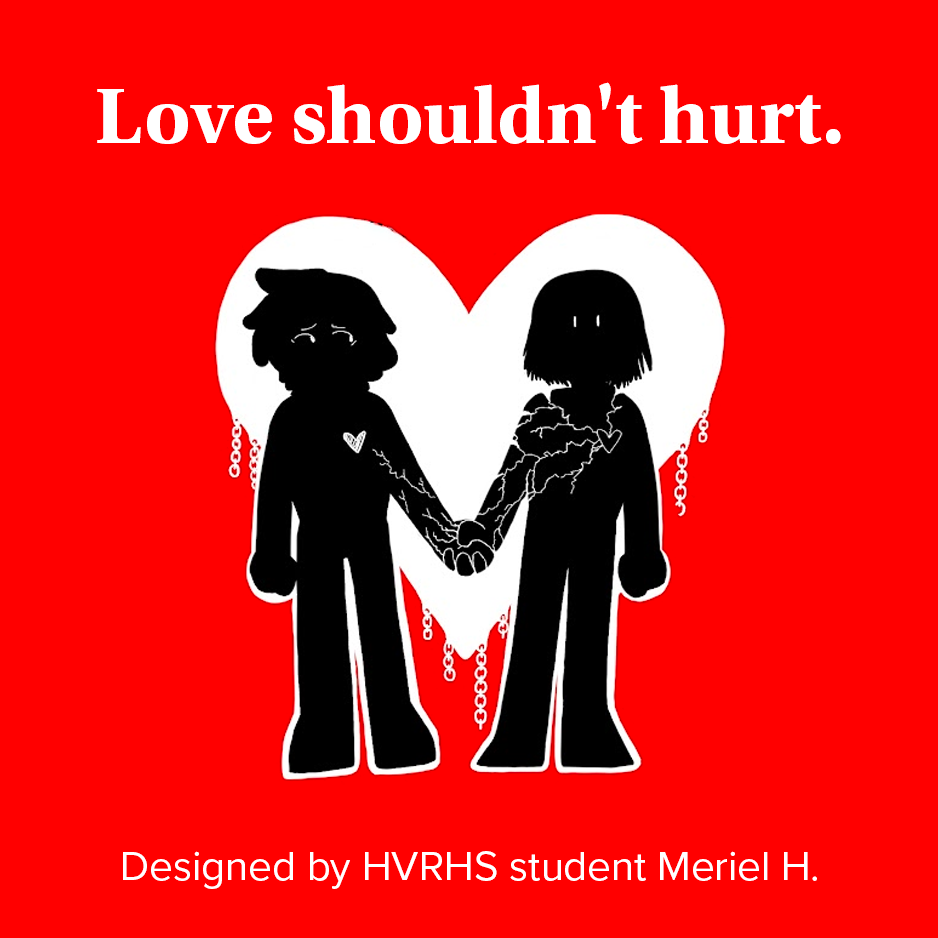
2026 Winning Design
February is Teen Dating Violence Awareness Month (TDVAM), and Project SAGE would like to have its annual TDVAM sticker be designed by a high school student! All are welcome to submit an entry, regardless of artistic background. Designs should promote a message of healthy relationships and raise awareness of teen dating violence, incorporating the message “Break the silence, end the violence.” A winning design will be chosen as Project SAGE’s Teen Dating Violence Awareness Month 2027 sticker, which will be printed and distributed throughout Region 1 and northwest Connecticut.
If you are interested
Sign up as soon as possible with:
Ms. Rice: jrice@region1schools.org
Mr. Tripp jtripp@region1schools.org
Entry Requirements
Designs should incorporate the message “Break the silence, end the violence”
Designs need to be submitted digitally in either a jpg or png file.
The winning design will be printed as a 3” x 3” square.
The design needs to include the following:
Project SAGE hotline (860) 364-1900
Project SAGE web address: Project-SAGE.org
The hashtag #TDVAM
Contestants can submit more than one entry.
How to submit
Submit entries by email to happening@project-sage.org
Deadline: Tuesday, November 24, 2026
Questions and support
Mrs. Vanicky: pvanicky@region1schools.org
Ms. Rand: lrand@region1schools.org
You Never Know What Someone Is Carrying
Sometimes, all it takes is one experience to change the way we see the people around us.

Sometimes, all it takes is one experience to change the way we see the people around us.
For Luke Twing, that experience came when someone close to him needed support during a difficult time. It opened his eyes to something many of us forget in the busyness of everyday life: we never truly know what another person may be carrying.
"It made me realize you don't know the battles people are going through," Luke shared. "We can be quick to judge, but we don't always see what someone else is facing."
That perspective is what inspired Luke to organize the Industry Softball fundraiser in support of Project SAGE. While the event is raising much-needed funds, Luke hopes it does something just as important—encourage people to lead with compassion, check in on one another, and remember that everyone deserves to feel safe, valued, and supported.
One thought from our conversation stayed with us:
"People can be made to feel like they're not worth anything. No one should have to experience that."
It's a simple statement, but a powerful reminder. Sometimes the most meaningful thing we can do is listen without judgment, offer support, or remind someone they don't have to face life's hardest moments alone.
We're deeply grateful to Luke, the Industry Softball Team, and everyone who has embraced this fundraiser with such generosity and heart. Their kindness is helping strengthen our community, raise awareness, and remind others that support often begins with one person who simply decides to care.

Something Worth Exploring
This month's reflection is about the power of feeling safe and the influence we all have in creating that feeling for others.

This month's reflection is about the power of feeling safe and the influence we all have in creating that feeling for others. These two conversations explore that idea from different perspectives—one through the realities of domestic violence and one through the science of trauma and healing.
Whether you're listening during a walk, while gardening, or on your morning commute, we hope these conversations offer new perspectives and inspire meaningful reflection.
Domestic Violence Crisis Now Impacts 1 in 2 Women
Oprah Winfrey with Rachel Louise Snyder
Rachel Louise Snyder helps us look beyond physical abuse to better understand coercive control, emotional safety, and why awareness matters. It's a thoughtful conversation that deepens our understanding of domestic violence and the importance of supporting those affected.
Healing Your Childhood Trauma
Oprah Winfrey with Dr. Bruce Perry
Dr. Bruce Perry explores how our early experiences shape the way we relate to others and why feeling safe is essential to healing, connection, and resilience. It's a powerful reminder that compassion and understanding can change lives.
The Power of Feeling Safe
Most of us think about safety as only protection from harm. But feeling safe is also about how people make us feel.
Most of us think about safety as only protection from harm. But feeling safe is also about how people make us feel.

It's knowing your voice matters. Being listened to without judgment. Feeling accepted for who you are. Knowing you don't have to face life's challenges alone.
When people feel safe, they're more likely to speak honestly, ask for help, build trusting relationships, and feel a sense of belonging.
The way we treat one another matters more than we sometimes realize.
Every day, we help create that feeling—when we truly listen, stay open to someone else's perspective, offer support without judgment, and create space for people to be who they are and where they are in their lives.
These moments may seem ordinary, but they can strengthen relationships—and sometimes change the course of someone's day.
Feeling safe is something every person deserves. And every one of us has the opportunity to help create it.
Healthy Relationships in Everyday Moments
Creating a sense of safety doesn't require extraordinary moments. It grows through everyday interactions.
The way we show up each day shapes our relationships, our workplaces, and our communities.
Sometimes creating safety is as simple as...
Listening without judgment.
Staying open to someone else's perspective.
Recognizing that every person has a story we may never fully know.
Offering support before solutions.
Helping people feel seen, heard, and accepted.

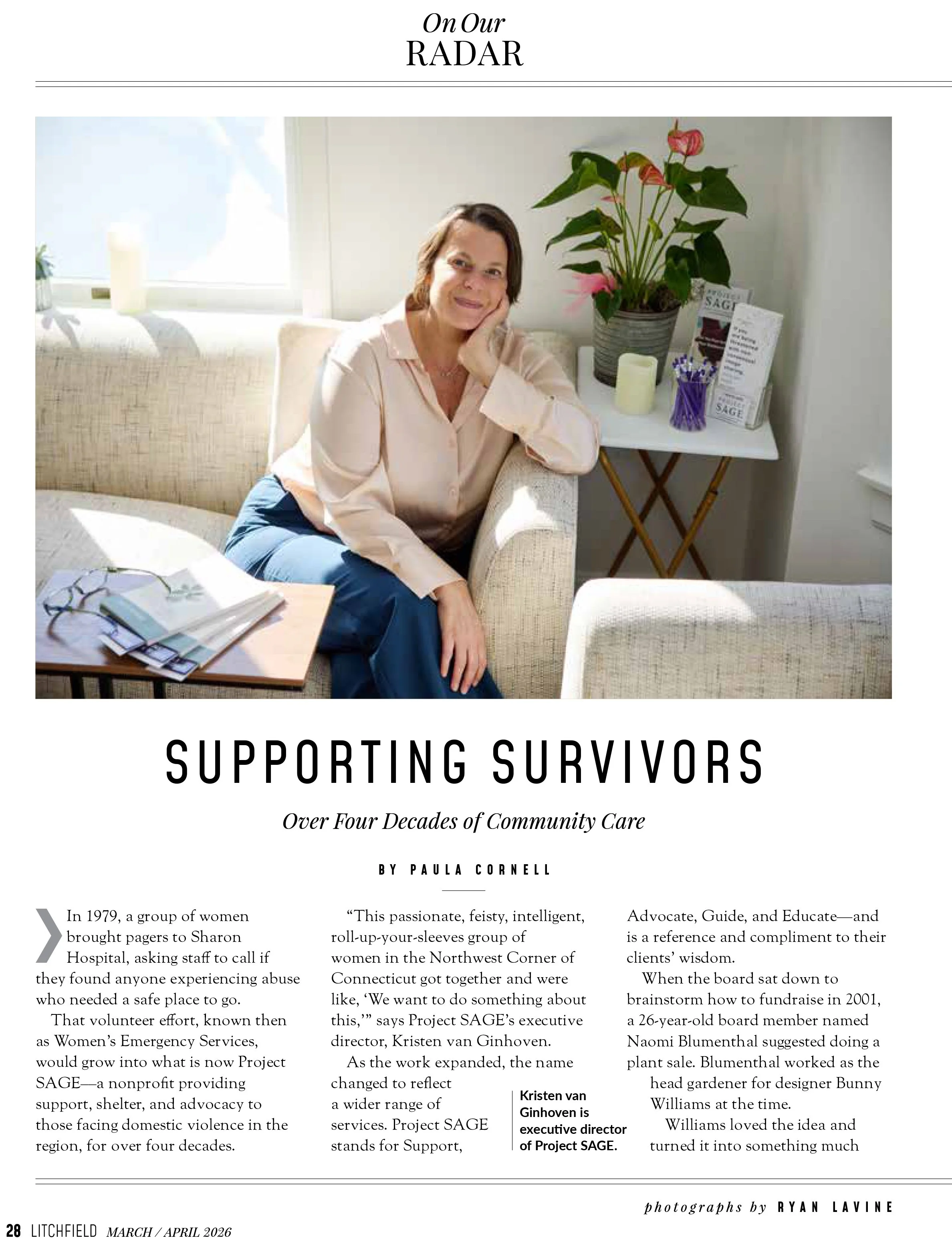
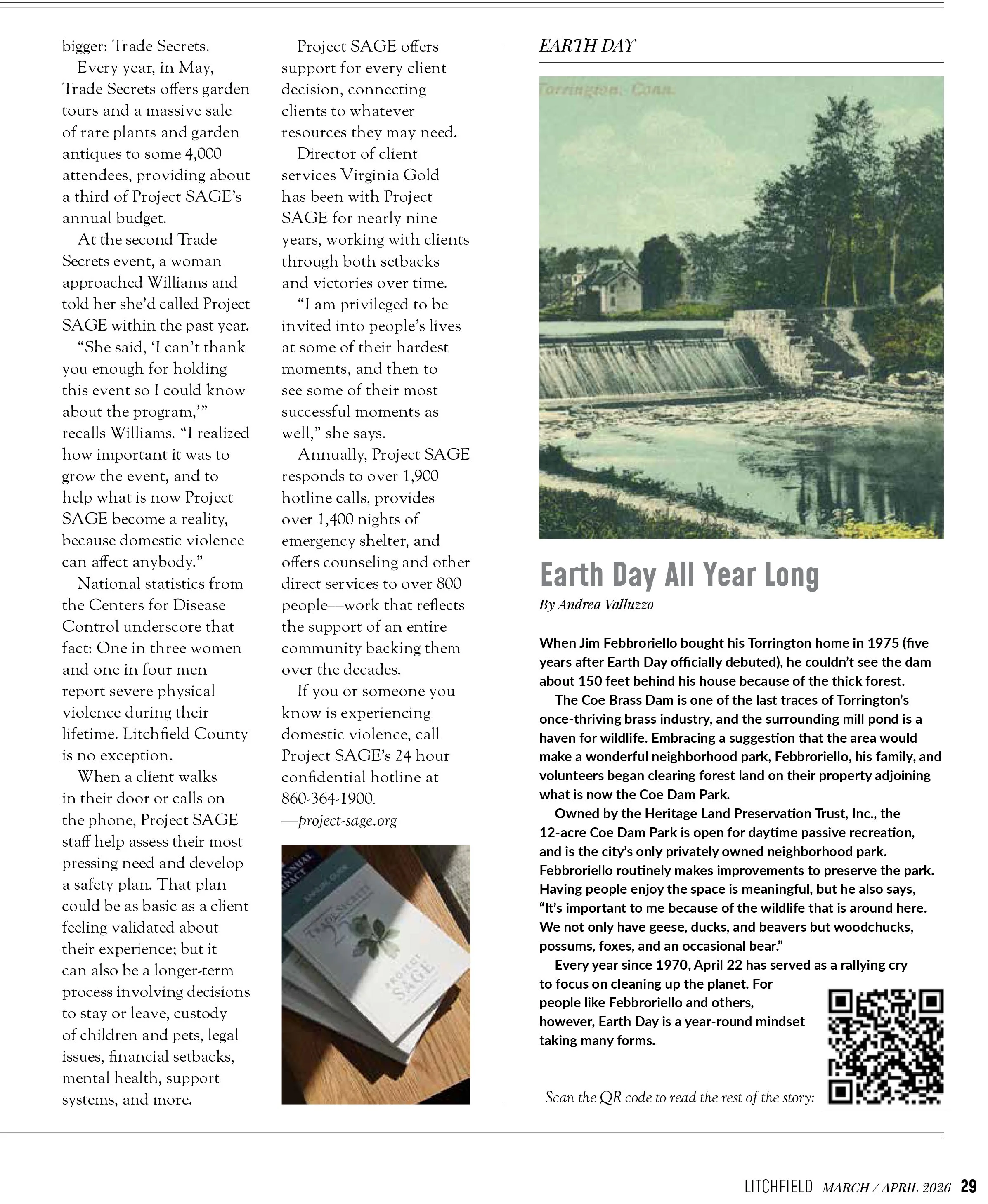
Supporting Survivors
In 1979, a group of women brought pagers to Sharon Hospital, asking staff to call if they found anyone experiencing abuse who needed a safe place to go.
Over Four Decades of Community Care
By Paula Cornell | Litchfield Magazine
Expanding Our Space, Deepening Our Support
With our renovation now underway, our vision is becoming real.
Domestic violence doesn't always look the way people expect.

Today, it can show up quietly—in isolation, patterns of control, restricted access to resources, or digital monitoring. It can be harder to recognize, and often, harder to talk about. At the same time, more individuals, families, and community members are seeking not only support—but guidance, education, and tools to better understand relationships and recognize healthy and unhealthy patterns.
This is where Project SAGE builds on its longstanding work in a more expansive way.
For years, we’ve imagined a space that could do more than respond in moments of crisis. A space that could also help prevent harm before it happens. A space where people could come to learn, to connect, and to feel supported—at any stage of their experience.
With our renovation now underway, that vision is becoming real.
This expanded space will allow Project SAGE to deepen the support it provides to individuals and families—offering more privacy, comfort, and stability during what are often incredibly complex and emotional transitions.
It will also allow us to grow into a true community hub for Northwest Connecticut—bringing together support services, education, and community engagement under one roof.
Because prevention doesn’t happen in isolation.
And support doesn’t happen in just one moment.
It happens over time—through awareness, connection, and trust.
This space is designed to support that journey—every step of the way.
What Will Make This Possible?
With the completion of our Lakeville renovations, Project SAGE will be able to:
Create trauma-informed spaces that promote healing and dignity for survivors
Expand prevention and education programs that build resilience for youth and the broader community
Strengthen outreach and partnerships with healthcare providers, schools, law enforcement, and social service agencies
Provide families in crisis with resources and environments that support rebuilding and recovery
Designed with Care, for Real Life
Every element of the renovation has been thoughtfully designed to support both immediate needs and long-term stability.
Spaces for support and connection
Renovated client service spaces for support groups, workshops, and counseling
Flexible community meeting and training space for prevention education and collaboration
Spaces for daily stability
A fully equipped kitchen, laundry facilities, and family gathering room to support families in transition
Safe, accessible, and welcoming design
ADA-compliant bathrooms, entries, and ramps
Enhanced fire and safety systems
Upgraded HVAC, plumbing, electrical, and energy efficiency systems
Outdoor and family-friendly space
A small, secure fenced outdoor area for children and pets
Landscaping designed to create a peaceful, welcoming environment
A Milestone Moment
In 2022, Project SAGE moved into our building on Porter Street in Lakeville. Since then, we have worked to create a safe and welcoming space for survivors, families, and community partners.
With design now complete and construction underway, we are excited to move forward with the final renovations that will bring this vision fully to life.
We look forward to sharing more as the space continues to take shape—and to welcoming our community into it in the months ahead.
Considering Volunteering with Project SAGE?
Project SAGE volunteers support people in a wide range of practical, meaningful ways.
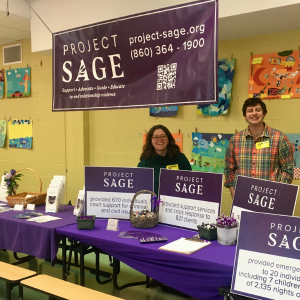
Project SAGE volunteers support people in a wide range of practical, meaningful ways. Some answer phones or help with outreach. Others support families by accompanying clients to appointments, helping set up safer housing, or assisting with early childhood programs. Behind the scenes, volunteers also help organize donations and keep our office running smoothly. While the work can be challenging at times, volunteers often tell us it feels deeply human, grounded, and impactful.
Becoming a Project SAGE volunteer begins with training. Our training is designed to be thoughtful, supportive, and realistic — offering practical skills alongside a deeper understanding of the work. Throughout the process, we emphasize that volunteers are never expected to do this alone.
“Yes, it’s tough material — but as a team, you make it accessible.”
— Project SAGE Volunteer
For many people, volunteering becomes a meaningful chapter that stays with them — whether it leads to continued service, professional growth, or a deeper connection to the community.
“My time at Project SAGE had a profound impact on me and helped clarify the work I feel called to do.”
— Former Project SAGE Volunteer
Spring 2026 Volunteer Training
Our Spring 2026 training cohort will meet for six consecutive weeks beginning April 23, on Thursdays from 3:00–5:00 pm at Scoville Library. Participants who cannot attend in person may join virtually. For each week of training, participants should expect approximately two hours of at-home work.
A Note from Stacy
One trend we’re seeing more of is values-aligned philanthropy — giving that reflects not just what someone supports, but why.
Project SAGE’s Development Manager

In my role at Project SAGE, I have the privilege of working with donors and community partners who care deeply about this work and the people it serves. Alongside my colleagues Brenna, Stephanie, and Nichole, I spend a lot of time listening — learning what matters most to people and helping connect their values with meaningful, lasting impact.
One trend we’re seeing more of is values-aligned philanthropy — giving that reflects not just what someone supports, but why. Many donors want to understand how their support helps sustain Project SAGE’s work over time. Tools such as donor-advised funds (DAFs), gifts of appreciated stock, and planned giving options can offer thoughtful and flexible ways to give, often while providing financial or tax benefits as well. Across all of this, transparency, trust, and long-term sustainability matter more than ever.
I’m always glad to connect with individuals who are curious about Project SAGE’s work and how they might engage in ways that feel right for them. If that sounds like you, I hope this note feels like an open door.
Learn more:
What is a Donor-Advised Fund? (Fidelity Charitable)
IRS guidance on charitable contributions (IRS website)
What is planned giving? (Planned Giving)
Anatomy of a Scam
I had a rude surprise in early December 2025 when three extremely convincing cyber thieves defrauded me.
How Urgency and Secrecy Pull You In
By The Reverend Dr. Eileen Epperson, Project SAGE volunteer since April 2023
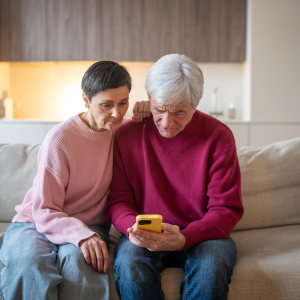
I had a rude surprise in early December 2025 when three extremely convincing cyber thieves defrauded me. I am on a mission now to enlighten younger and elder folks about the unpredictability and sophistication of these criminal teams which will only worsen with Artificial Intelligence unregulated.
I tapped on a message at the top of my emails: “3 More Messages.” Suddenly, there was a red screen that stopped everything. I know now that I should have shut off the laptop and visited my computer expert that day.
I called the Microsoft Office Support number in my phone which had been stolen by this group. I thought I was speaking to a Microsoft agent.
This was a team of three skilled shysters. The first man convinced me that foreign agents had stolen my identity. “Hackers have gotten into your computer, ma’am, and have control of your bank account. You pre-approved a withdrawal of $_____ within two hours to buy kiddy porn!” I was horrified. I was then sent to someone in the “Fraud Prevention Department” of my bank who was going to protect me.
The brilliance of this scheme was how this second man anticipated my objections in advance of everything he was advising me to do. He did so with authority and details. He stayed on the phone with me for three days directing all my actions.
This is a classic example of a swindle: urgency, secrecy, and trust-building by the schemer. I had to get my money out of my bank asap and convey it to a safe place (a Bitcoin machine). I should not tell anyone about this, including my partner. The specialist had leverage in the highest echelons of the Federal government.
The lessons: if a Bitcoin machine is mentioned, hang up. If urgency and secrecy are in the equation, hang up. If in doubt, hang up. Do not open anything you do not recognize on your phone or computer. We all must educate ourselves about the ingenious methods devised daily to fool us into giving away our money.
When Money Is Used as Control in Relationships
Financial abuse is a common but often overlooked part of domestic violence.
How Financial Abuse Can Show Up in Domestic Violence

Financial abuse is a common but often overlooked part of domestic violence. It occurs when one partner uses money or financial resources to gain power or control within a relationship. This can include limiting access to bank accounts or credit cards, controlling how money is spent, withholding financial information, or interfering with someone’s ability to work or earn income. These behaviors may develop gradually and can exist alongside other forms of control.
Access to money is closely connected to safety, stability, and choice. Advocates consistently find that financial abuse is present in the vast majority of domestic violence cases and is a significant reason people may remain in, return to, or struggle to leave unsafe relationships. When someone does not have reliable access to financial resources, everyday decisions — such as housing, healthcare, transportation, or supporting children — can become much more difficult.
Forms of Financial Abuse
Like other forms of abuse, financial abuse can begin subtly and may become more restrictive over time. In some relationships, one partner may take on greater responsibility for managing money — particularly during periods of stress or transition — and financial decisions may slowly become less shared. Over time, this can shift into a pattern where one person has increasing control over financial information, access, or decision-making.
In other situations, financial control may be more direct, with one partner limiting the other’s ability to work, earn income, or access family funds. Whether subtle or more overt, these patterns can be difficult to recognize while they are happening. Understanding the different ways financial control can show up helps bring clarity to experiences that may otherwise feel confusing or hard to name.
Ways Financial Control Can Show Up
(These patterns can look different in every relationship.)
Limiting access to bank accounts, credit cards, or financial information
Controlling how money is spent or requiring approval for everyday purchases
Interfering with someone’s ability to work, earn income, or pursue training
Withholding money needed for basic expenses like food, medicine, or transportation
Creating debt in another person’s name or damaging shared credit
Monitoring or questioning spending in ways that create fear or pressure
Youth Voices in Action
February is Teen Dating Violence Awareness Month (TDVAM).
February is Teen Dating Violence Awareness Month (TDVAM) — a time to pause, learn, and pay closer attention to how young people experience relationships.
Many people don’t realize that dating abuse among teens often shows up without physical violence. Nearly 1 in 3 teens in the U.S. experiences some form of dating abuse, including emotional pressure, control, or digital monitoring. These experiences often begin quietly, which is why awareness and early conversation matter.
This month, we’re grateful for a meaningful collaboration with Housatonic Valley Regional High School, where students in grades 9–12 were invited to design an awareness-raising sticker focused on healthy relationships. With support from health teachers Jeff Tripp and Jacquie Rice, art teachers Patricia Vanicky and Lilly Rand, and Principal Ian Strever, the project centered youth voice as an important part of prevention.
We extend special thanks to student artist Meriel H., whose design was selected, and to the HVRHS faculty who supported the printing and production of the stickers. When young people help shape the message, conversations about healthy relationships become more relevant — and more likely to resonate with their peers. This partnership reflects what early prevention can look like: informed, creative, and rooted in community.

February Newsletter
Today, domestic violence includes more than physical harm. It can also involve patterns of coercive control, often without visible signs and across all ages, backgrounds and genders.
Welcome to our monthly letter from Project SAGE - a space where we share how we support those impacted by domestic violence, the role education plays in prevention, and the partners and moments that shape our work.
Today, domestic violence includes more than physical harm. It can also involve patterns of coercive control – such as emotional manipulation, financial control, digital monitoring – often without visible signs and across all ages, backgrounds and genders.
New Year’s are often a time when questions come into focus — about what feels right, what’s shifted, and where more clarity might help. At Project SAGE, conversations often begin in the same place: with questions rather than answers. One question we hear often is: “Do I have to be in crisis to reach out?”
The short answer is no.
At Project SAGE, we’re here to listen and support people through moments ranging from urgent to uncertainty. Support at Project SAGE isn’t one-size-fits-all. Many people contact us simply to talk things through — to ask questions, sort out concerns, or getting guidance about a situation that doesn’t feel quite right. Some reach out for themselves; others are looking for ways to support a child, a friend, or a family member. There’s no expectation to take action, make decisions, or label what’s happening — unless and until someone is ready. Often, the first step is just a conversation.
What matters most is that support adapts to each person’s situation — and moves at a pace that feels right for them.
So, if questions come up — for you or for someone you care about — just know Project SAGE is here.
SAGE Around Town
You’ll see Project SAGE around town this February with a small table at NBT Bank (5 Bissell Street, Lakeville). Stop by to find information about our work, a few rotating swag items, and a stack of books you’re welcome to take home — no checkout, no returns, just like a little free library.
We’ll also be out and about at the Kent Chocolate Fest — a favorite local event supporting the Kent Center School Scholarship Fund. If you’re going, we hope you’ll grab a treat and enjoy the festivities: Kent Center School, February 11, 3:30–5:00 pm. (Snow date: February 12)
Become a Trade Secrets Underwriter!
Trade Secrets is Project SAGE’s annual fundraiser, and underwriting makes it possible.
Underwriters cover the cost of the event so that 100% of proceeds directly support Project SAGE’s free, confidential programs for victims and survivors of interpersonal and relationship violence—representing nearly 30% of our annual operating budget.
From the Activist Level ($300) to the Visionary Level ($15,000), each underwriting level includes meaningful benefits and exclusive access—while directly investing in safety, advocacy, prevention, and education in our community.
NEW this year: Saturday Sip & Savor at Tenmile Distillery (included at select levels)
Thank you to our underwriters for making Trade Secrets—and our mission—possible. Learn more about underwriting opportunities on our website.
A Message of Gratitude from Project SAGE
A Year End Video From Our Executive Director, Kristen van Ginhoven. Watch now.
December Tech-Related Resources
A Special Roundup for the Year of Digital Safety. Check out these curated resources for a deeper understanding of digital violence.

ARTICLE: When Love-Bombing Is a Feature, Not a Red Flag
Popular AI companion apps don't passively wait for users to engage. They actively pursue interaction through carefully crafted push notifications that mimic the language of an attentive, sometimes needy, romantic partner. This AI “love bombing” is an intentional strategy to increase and maintain user engagement – and normalizes unhealthy relationships. Read about how to set healthy boundaries with AI here.
TOOLKIT: What Is Cyberstalking?
Cyberstalking is the misuse of technology to harass, stalk or threaten an individual. This toolkit helps you understand what cyberstalking is so you can better assess and understand your situation.
December 2025 Resources Roundup
Curated resources to help you be informed about the work and advocacy of Project SAGE.

OPPORTUNITY: Changing the way we see, act, and think about masculinity…
Next Gen Men is launching its 2026 Youth Advisory Council, and they want your kids ages 13 to 17 to help lead the way. In exchange for sharing insights on what engages young people online, members of the Council will receive a paid honorarium and build important life skills. Click for details and to apply.
VIDEO: Surviving Post-Separation Abuse: Supporting Survivors After Escaping Domestic Violence
"Just leave and you'll be safe." This widely held misconception that abuse ends after a victim leaves a domestic violence situation places these survivors and their families at risk. The desire to maintain power and control of an intimate partner does not end when the relationship ends for an abusive partner. Thus, the abuse continues in ways that we know of as post-separation abuse. This video shares strategies that you can use to support survivors and mitigate these behaviors of post-separation abuse to improve the likelihood of safety for themselves and their children.
A severe problem hiding in plain sight, human trafficking affects millions of people around the world – including many in our very own communities. Find information and resources for healthcare professionals, educators, law enforcement personnel, and other community members.

Community Spotlight: Talking About Online Safety For Teens
This month, Project SAGE was grateful to join the David M. Hunt Library for an important community conversation on online risks facing teens today.
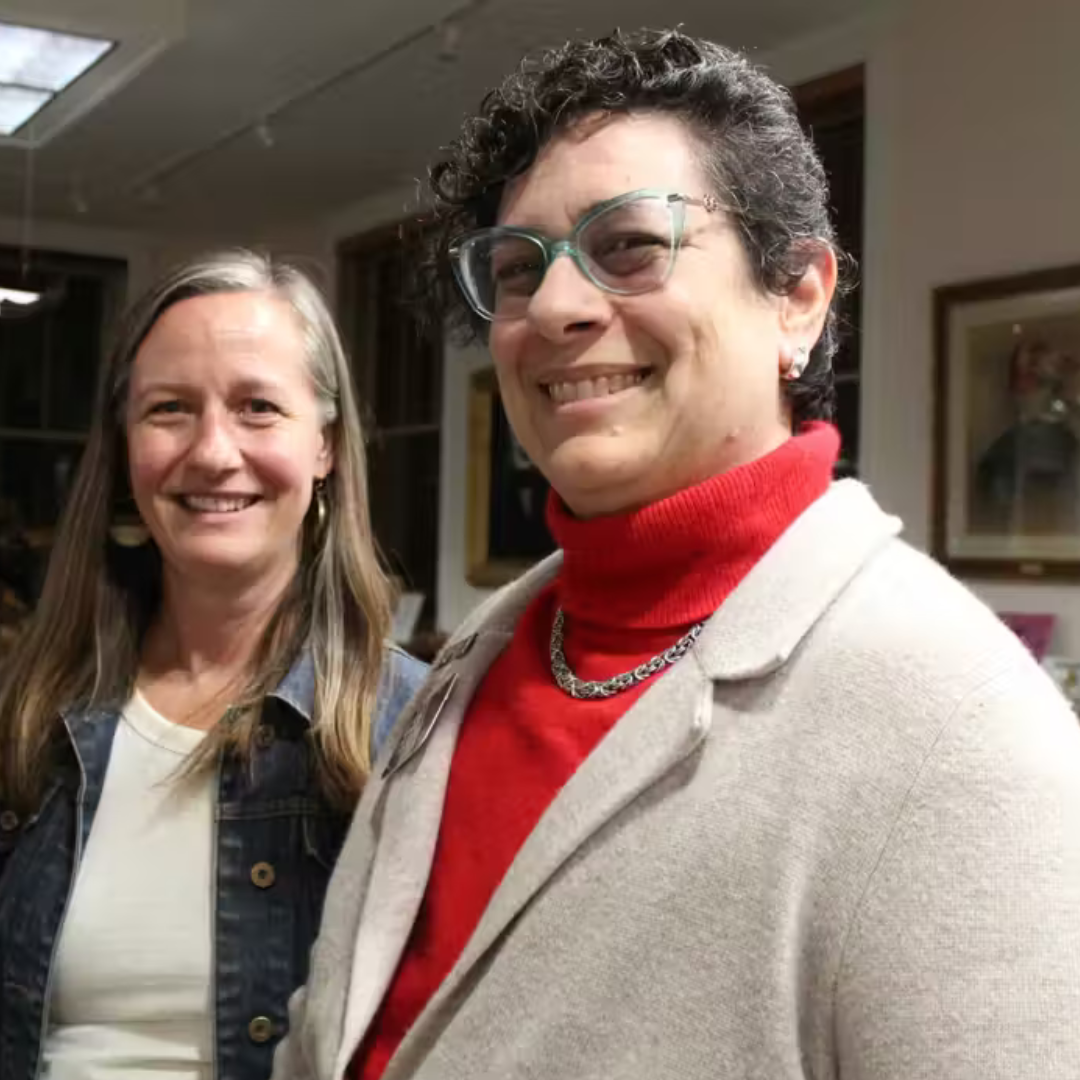
This month, Project SAGE was grateful to join the David M. Hunt Library for an important community conversation on online risks facing teens today. Our Director of Community Engagement, Linda Ciano, led the program, sharing practical insights and tools for parents, caregivers, and all who support young people in our region
We’re always inspired by how our community shows up for one another - and how these shared conversations can make a real difference in keeping teens safe.
The Lakeville Journal covered the event, and you can read the full article here.
Thank you David M. Hunt Library, for hosting us and for your partnership.
Community Support Makes the Holidays Brighter
The holidays are approaching, and Project SAGE is grateful to all our dedicated community supporters who are helping make this time of year special for our clients.

The holidays are approaching, and Project SAGE is grateful to all our dedicated community supporters who are helping make this time of year special for our clients.
Thanks to generous in-kind donations of new books and toys, parents will be able to select holiday gifts for their children from the shelves of our Kids’ Closet. The earnest efforts of the Women’s Initiative at Temple Beth David have brought in scores of gas cards that clients are using to get to work, school, doctors’ appointments, and more. And dedicated supporter Francesca Donner is currently heading up a supermarket card drive that will help ensure that every one of our families in need has food for the holidays and beyond.
Whether it’s a donation of costume jewelry for our “The Bling’s the Thing” fundraiser or an hour of time spent volunteering to assist with the myriad tasks that make up the day at Project SAGE, every bit of community support helps us help others.
So, THANK YOU to everyone reading this message. We couldn’t do this work without you.
October & November 2025 Resource Roundup
Curated resources to help you be informed about the work and advocacy of Project SAGE.

ARTICLE: An Alarming Trend: Moms Sentenced to Jail for Keeping Kids from Abusers
There is an ongoing epidemic some may say is more dire than violence against women. It’s the criminalization of women who try to protect their children from violence. Often referred to as “protective mothers,” these survivors of abusive partners are desperately trying to shield their children from being weaponized by their abusive fathers. These abusers often involve the legal system, law enforcement, child counselors and evaluators, even their own family members, in a relentless and complicated, long-term assault, doing anything and everything in their power to make sure the woman who dared to gain the courage to leave them may never see their children again, and, to top it off, find herself behind bars if she tries.
REPORT: Anti-Bullying Policies in School and LGBTQ+ Young People
LGBTQ+ young people report higher rates of bullying than their straight, cisgender peers. Experiences of bullying are associated with higher rates of suicide attempts, which are already disproportionately high among LGBTQ+ young people. The good news is that LGBTQ+ young people who attend schools with LGBTQ+-inclusive anti-bullying policies report lower rates of attempting suicide compared to their peers at schools without such policies.
ARTICLE: Spotlight on Shelter: A Day at SafeHouse
What does a typical day at a domestic violence shelter look like? Shelter life is unpredictable but built on care. Every day brings crises, laughter and community, and staff “make it happen” no matter what arises.
PODCAST: The War We Owe Them Interview with PACT CEO Lori Cohen
The Detectives Podcast is a show hosted by two active detectives who are going beyond sensationalized true crime and pulling back the curtain on investigative work. In this episode, they discuss what trafficking does and does not look like, how parents can protect their children as they navigate online spaces, ongoing advocacy for legislation that creates a safer Internet, and more.
October & November 2025 Tech-related Resource Roundup
A Special Roundup for the Year of Digital Safety. Check out these curated resources for a deeper understanding of digital violence.
CALL TO ACTION: A.I. LEAD Act: A Bipartisan Effort to Confront the Supercharged Harms of A.I.
When Adam discovered ChatGPT, he began using it as a tool to assist with his schoolwork. As time progressed, ChatGPT became his companion and confidant. And when Adam developed suicidal thoughts, ChatGPT gave Adam the exact plan to end his life. The AI LEAD Act, sponsored by Senators Josh Hawley (R-MO) and Dick Durbin (D-IL), would ensure AI chatbots are developed safely and, when they’re not, ensure accountability.
GUIDE: Safety Net Project
Technology is evolving quickly, and artificial intelligence (AI) tools are becoming part of more and more everyday experiences. While AI does have the potential to save time and expand access to resources, these same tools can also introduce serious safety, privacy, and trust risks. This guide was created to support you in making informed, confident choices about if or how you use AI, on your own terms.
ARTICLE: Reducing the Risk of Image Nudification
In the age of advanced image-editing tools and artificial intelligence, image nudification has become a serious and impactful problem. “Nudification” refers to the digital manipulation of images to make a person in it appear nude when they were not. This post explains what nudification is, how it typically works at a basic level, and why it can be so damaging.
REPORT: What We’ve Learned About the Online Lives of Boys Who Are Embracing Positive Masculinity
As part of an ongoing mission to support boys’ well-being, Next Gen Men decided to take on a research project designed to better understand their feelings, stresses and needs. What they uncovered was a surprising distance between their beliefs and attitudes about toxic and positive masculinity, and their lived experiences—particularly online. The vast majority of the boys in the survey privately challenged traditional pressures of masculinity like toughness, dominance or hypersexuality. Those same boys, however, consistently perpetuated or witnessed those harmful norms in their online lives.
FREE COURSE: Become a Child Safety Champion
Every day, children navigate an increasingly complex digital world. 58% of minors report having a harmful online experience, and 36% of minors report being offered something in exchange for sexual imagery. Thorn has created a free six-week course for parents, educators, and other caregivers to recognize warning signs of grooming and sextortion, navigate conversations about digital boundaries, and support children who may have been targeted.
IRL Learning to Stay Safe Online
As part of Project SAGE’s Year of Digital Safety, the Prevention Education team has been busy spreading the word about how to stay safer online.

As part of Project SAGE’s Year of Digital Safety, the Prevention Education team has been busy spreading the word about how to stay safer online. The key: leaning into IRL (“in real life”) relationships and assembling a trusted team for support before problems arise. This is especially important for teenagers, who are more likely than any other age group to suffer from digital abuse, including cyberbullying, digital harassment and stalking, and nonconsensual image sharing (sometimes referred to as “revenge porn”).
Parents – do you want to learn more about how you can help keep your kids safer online? Check out the resources below and then Join Project SAGE at 7pm on Thursday, November 20, at the David M. Hunt Library for the free workshop Digital Safety for Youth: What Parents Should Be Talking About. Details and registration here.
Family Online Safety Agreement